Round-Trip
Fare (Jan. 5): President Nixon signs a bill authorizing a $5.5
billion six-year program to develop a space shuttle craft that will lift
off as a rocket and return to Earth as an airplane.
Round-Trip
Fare (Jan. 5): President Nixon signs a bill authorizing a $5.5
billion six-year program to develop a space shuttle craft that will lift
off as a rocket and return to Earth as an airplane.
Bloody Sunday Redux (Jan. 30): On a day that will become known as the second "Bloody Sunday," British troops kill 13 men in Londonderry, Northern Ireland, during a Roman Catholic civil rights rally held in defiance of a government ban.
 |
|
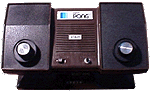
| Pong |
Video Volley: Atari debuts Pong, the first commercially successful video game.
Paralyzing Shot (May 15): Gov. George C. Wallace of Alabama, an independent presidential candidate, is shot and critically wounded after a campaign speech in Laurel, Md. The attack leaves Wallace paralyzed from the waist down. On Aug. 4, Arthur Herman Bremer, 21, is convicted of the attack and sentenced to 63 years in prison.
Executions Get the Ax (June 29): The U.S. Supreme Court rules that capital punishment is "cruel and unusual punishment" and is unconstitutional.
 |
|
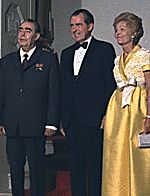
| Soviet General Secretary Leonid Brezhnev (left) with President and Mrs. Nixon |
Cold War Thaw (July 8): President Nixon announces a three-year trade pact between the United States and the Soviet Union.
Chess Master (Sept. 1): Bobby Fischer becomes the first American to win the international chess championship in Reykjavik, Iceland.
Olympic Terror (Sept. 5): Nine Israeli hostages, five of their Arab captors and a policeman die in gunfire at an airfield in Munich, West Germany. It ends a day of terror that began when Palestinian guerrillas killed two other members of the Israeli contingent to the Olympic Games in their quarters at the Olympic Village. The XX Olympiad is suspended for two days. It's at the same Olympics that U.S. swimmer Mark Spitz wins an unprecedented seven gold medals.
Dow Hits 1,000! (Nov. 14): The Dow Jones Industrial Average closes at 1,003.16, finishing above 1,000 for the first time.
End of Life (Dec. 29): Life magazine, a pioneer in photojournalism, suspends publication.
|
What's Hot
Women's
liberation achieves full flower in 1972. The FBI swears in its first
female agents, and America's first female rabbi is ordained. In
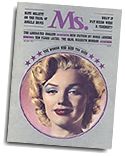
July, Gloria Steinem launches Ms. magazine. Its 300,000 copies sell
out in eight days. Congress passes Title IX, legislation prohibiting
discrimination against females in federally funded education, including
athletics programs. On March 22, the Equal Rights Amendment, prohibiting
gender discrimination, passes Congress and is sent to the states
for ratification. But by year's end, only 22 of the required 38
have given approval. Births
Mia Hamm, soccer player (March 17) Deaths
Jackie Robinson, first black major league baseball player (born 1919) Howard Johnson, restaurateur (born 1897) Mahalia Jackson, gospel singer (born 1912) Roberto Clemente, baseball player (born 1934) |
 'Hear
Me Roar'
'Hear
Me Roar'