 Death
Sticks (Jan. 11): Cigarette smoking is labeled the "single
most important environmental factor contributing to early death," in a
report issued by U.S. Surgeon General Julius B. Richmond.
Death
Sticks (Jan. 11): Cigarette smoking is labeled the "single
most important environmental factor contributing to early death," in a
report issued by U.S. Surgeon General Julius B. Richmond.
Birth of a Nation (Jan. 30): White voters in the southern African nation of Rhodesia ratify a new constitution, enfranchising all blacks, establishing a black-majority Assembly and Senate, and changing the country's name to Zimbabwe.
 |
|
| Basketball autographed by Bird and Johnson |
Basketball Fever (March 26): Larry Bird and Earvin "Magic" Johnson, the top college basketball players, face off in the NCAA championship and capture the attention of a national television audience. Their continuing rivalry will help revitalize the NBA.
Nuclear Scare (March 28): Mechanical malfunction and human error combine to create the worst nuclear accident in U.S. history. On the day of the accident at the Three Mile Island nuclear generating plant in Middletown, Pa., company officials say there has been no radiation release and that the plant is cooling down. But within days, there is fear of a meltdown. Gov. Richard Thornburgh closes nearby schools and recommends that pregnant women and young children within 5 miles of the plant evacuate. An estimated 80,000 to 250,000 people flee. The weeklong crisis ends as officials stabilize the damaged reactor, but Three Mile Island stokes opposition to the expanding nuclear-power industry.
A Soviet Vietnam: The United States is still coming to grips with the aftermath of its Vietnam debacle when the world's other superpower, the Soviet Union, wades into a quagmire of its own. The first Soviet troops invade neighboring Afghanistan on Dec. 26 to replace an independent-minded communist government with a more pliant one, only to heighten the ire of fundamentalist Muslim mujahedeen, or "holy warriors."
 |
|
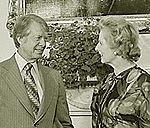
| Thatcher with President Carter in 1977 |
Iron Lady (May 3): Margaret Thatcher, a grocer's daughter who became an Oxford-educated chemist and lawyer, becomes Britain's first female prime minister as her Conservative Party captures 44 percent of the popular vote and a 43-seat majority in Parliament. She will remain in office 11 years -- the longest tenure of any 20th century British prime minister.
Top IRA Target (Aug. 27): Lord Louis Mountbatten, great-grandson of Queen Victoria, World War II admiral and British viceroy of India, becomes the most famous victim in the Irish Republican Army's 10-year guerrilla campaign to drive Britain out of Northern Ireland. Terrorists blow up his 29-foot boat as he, a 14-year-old grandson and a friend of the grandson are setting out for a fishing excursion. The two boys also die.
Traveling Pope (Oct. 1-7): Pope John Paul II pays a six-day visit to the United States, stopping in Boston, New York, Philadelphia, Chicago, Washington and Des Moines, Iowa. On Oct. 6, he becomes the first pope to meet a U.S. president at the White House.
'Death to America' (Nov. 4): Elizabeth Swift, political officer at the U.S. Embassy in Tehran, reports that a mob of young Iranians has broken into the embassy compound. The attackers set fires, force their way into offices and eventually begin to tie the hands of embassy workers. "We're going down," Swift reports to Washington before a captor grabs the phone. She is blindfolded with more than 60 others and led into captivity. The Iranian hostage crisis has begun. Angry Iranian mobs, shouting "Death to America!" become a daily feature on evening news broadcasts.
Humble Acceptance (Dec. 10): Mother Teresa, a Roman Catholic nun who has worked with the poor in India's festering slums, accepts the Nobel Peace Prize. "Personally, I am unworthy," the 69-year-old nun tells the prize committee. "I accept in the name of the poor."
|
What's Hot
Evangelists
start making a play for political power when Jerry Falwell forms
the Moral Majority, saying, "This country is fed up with radical
causes, fed up with the unisex movement, fed up with the departure
from basics, from decency, from the philosophy of the monogamous
home." His goal is to push for legislation with the backing of a
large voting bloc of Christian conservatives. "Get them saved, baptized
and registered," he tells his staff. It won't be long before the
religious right has enormous influence over the Republican Party.
Critics questioning the group's tactics tell Americans that the
Moral Majority is neither moral nor a majority. Deaths Conrad N. Hilton, hotelier (born 1888) A. Phillip Randolph, civil rights leader (born 1889) Nelson Rockefeller, former New York governor and U.S. vice president (born 1908) Sid Vicious, punk rocker (born 1957)
John Wayne, actor (born 1907) Arthur Fiedler, conductor (born 1895) Richard Rodgers, composer (born 1902) |
 The
Moral Majority
The
Moral Majority

