 Big
Plane (Jan. 21): Boeing 747 jumbo jets go into trans-Atlantic
service for Pan American World Airways.
Big
Plane (Jan. 21): Boeing 747 jumbo jets go into trans-Atlantic
service for Pan American World Airways.
No Conspiracy (Feb. 18): In the Chicago Seven trial, a jury acquits all seven defendants charged with conspiracy to incite a riot during the 1968 Democratic National Convention. Five defendants are convicted of seeking to incite a riot through individual acts.
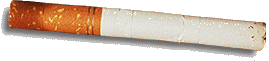
Cigarette
Ban (April 1): President Richard Milhous Nixon signs a bill
banning cigarette advertising on radio and TV, effective Jan. 1, 1971.
Protect Our Planet (April 22): Earth Day rallies, each involving up to 25,000 people in several large cities and at least 10 million schoolchildren, draw attention to global environmental problems.
 |
|
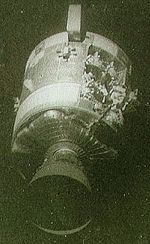
| Damaged module |
'Houston, We've Had a Problem' (April 13): Apollo 13 crew members hear an explosion in the service module, which houses the ship's main engine and most of its life-giving power and environmental systems. The lunar module, with its independent electricity and oxygen supplies, becomes the crew's lifeboat for most of the journey home. On April 17, Apollo 13 splashes down safely in the Pacific Ocean.
Campus Unrest: Rarely have Americans been so divided as in 1970 over the war in Vietnam. But the galvanizing event in this turbulent year is President Nixon's announcement April 30 that U.S. troops have entered Cambodia to destroy Viet Cong and North Vietnamese "headquarters" and "sanctuaries." The announcement sparks demonstrations at colleges and universities across the nation.
 May
4: A confrontation between National Guard troops and about 1,000 demonstrators
at Kent State University in Ohio results in the deaths of four students.
May
4: A confrontation between National Guard troops and about 1,000 demonstrators
at Kent State University in Ohio results in the deaths of four students.
May
14: At Jackson State College in Mississippi, two students are killed
and nine are wounded when police and state troopers open fire on a dormitory.
The explosion of rage results in the shutdown of 75 college campuses for
the rest of the academic year.
June
13: Nixon appoints a nine-member Commission on Campus Unrest. The
panel reports in the fall that some Kent State students were "dangerous,
reckless and irresponsible" but that the "61 shots by Guardsmen certainly
cannot be justified." The police shooting at Jackson State, the commission
says, was "an unreasonable, unjustified overreaction."
 |
|
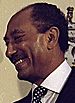
| Sadat |
Egyptian Succession (Sept. 28): Egyptian President Gamal Abdel Nasser dies of a heart attack. He is succeeded by Vice President Anwar Sadat.
Collegiate Wit (Oct. 26): Garry Trudeau takes his college cartoons national and gets a wider audience for his searing lampoons of American society. "Doonesbury" will become the first comic strip to win a Pulitzer Prize.
Socialist Experiment (Nov. 3): Salvador Allende takes office as president of Chile. He is the first Marxist to be elected head of a government in the Western Hemisphere by a democratic majority.
Fab Four Divorce (Dec. 31): Paul McCartney sues the other three Beatles -- Ringo Starr, John Lennon and George Harrison -- along with the group's manager, Allen Klein, asking that the group be legally dissolved.
|
What's Hot With
trumpet fanfares in London's Westminster Abbey, leaders of the Protestant
Churches of the British Isles are presented a new translation of
the Bible. The New English Bible is the culmination of 24 years
of work by British scholars. The aim is to make the Bible more relevant
to contemporary readers. But some critics complain that the new
translation lacks the sonorous majesty of the King James version,
published in 1611. Births Mariah Carey, singer (March 27)
Naomi Campbell, model (May 22) Deaths Mark Rothko, abstract expressionist (born 1903) Gypsy Rose Lee, stripper (born 1914 ) Jimi Hendrix, rock guitarist (born 1942) Janis Joplin, rock singer (born 1942) |
